I made a brass dividing plate by hand for my reconstruction of the Dominy’s wheel cutting engine. Here is a video of the process:
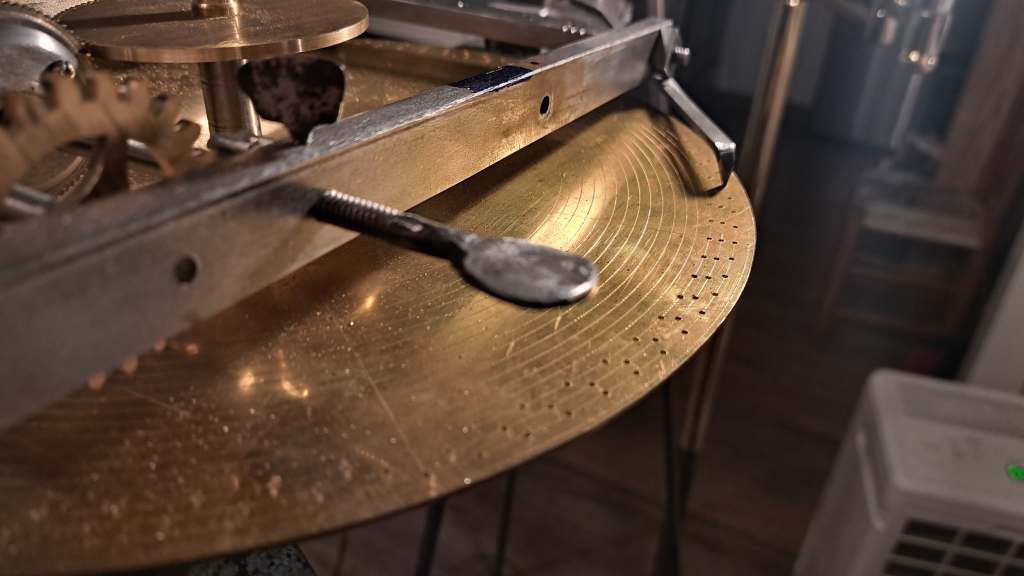
The dividing plate is a round disc with a series of concentric rings on its face that each have an evenly spaced number of holes. These holes are then used to divide a wheel or anything else mounted in the center of the plate into an equal number of teeth – the number being equal to the amount of holes on that ring, or a factor of the holes. To increase the range of divisions that can be made, the rings each have a different number of holes. The process of making it involved mainly a lot of work with dividers, similar to the manual dividing plate I made earlier.
To retroject computer parlance, the dividing plate stores the data of dividing a circle into equal parts, for use later when we need to divide a wheel to cut teeth into it. There is a lot of labor and knowledge needed up front to make one of these, the payoff being that later any wheel can be effortlessly divided up.
Two dividing plates exist for the Dominy’s, featuring divisions, from the outside in, of: 96, 84, 72, 64, 63, 60, 54, 48, 40, 30, 50, 62 for one plate and 96, 84, 80, 78, 186, 72, 64, 63, 60, 56, 54, 100, 88, 52, 70, 30 on the other. So far I have only made the 96, 84, 80 divisions, because they are quite fiddly to lay out. I will discuss what these division were actually used for in the Dominy’s clocks and products, as well as what they can tell us about the development of their craft over time in my masters thesis.
For now, I’d like to discuss a tool I had to make to make this dividing plate: a beam compass with a cutter. I used it to make the concentric rings in the plate, which are crucial to help locate the dividers consistently around the plate when laying out the holes.
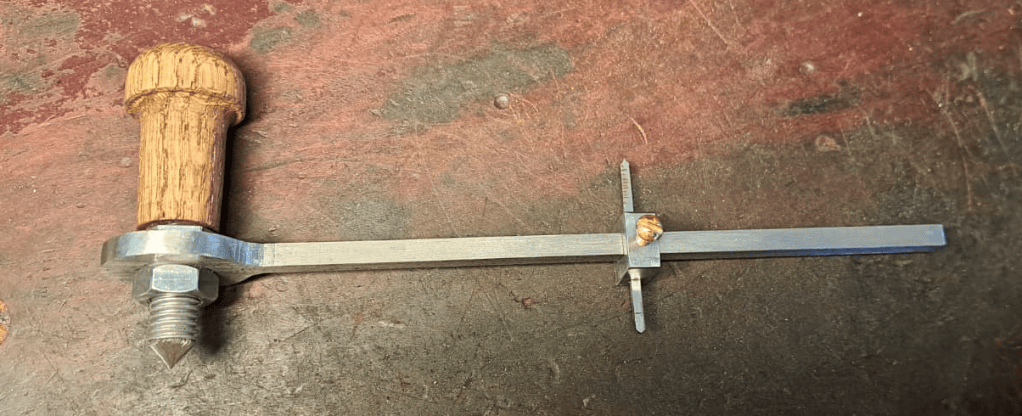
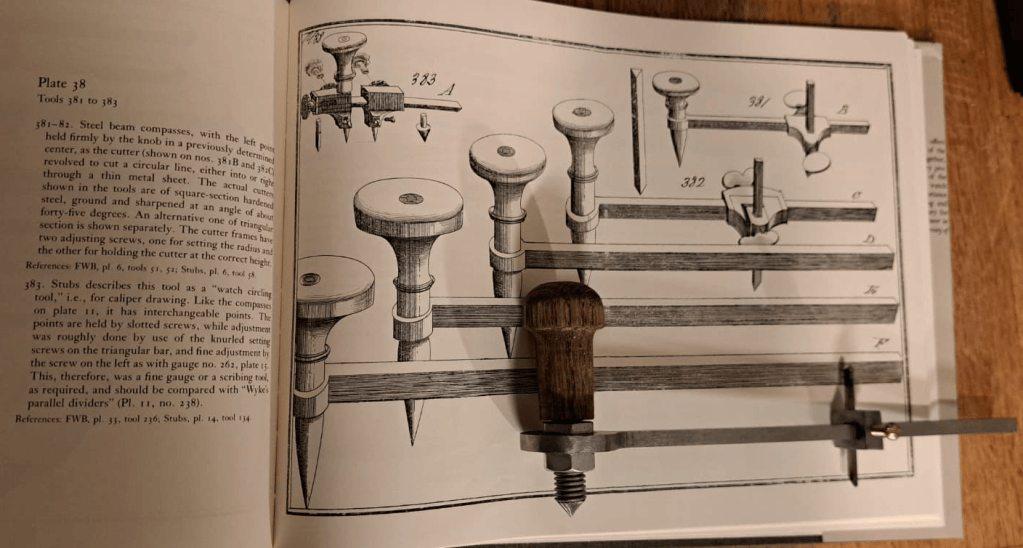
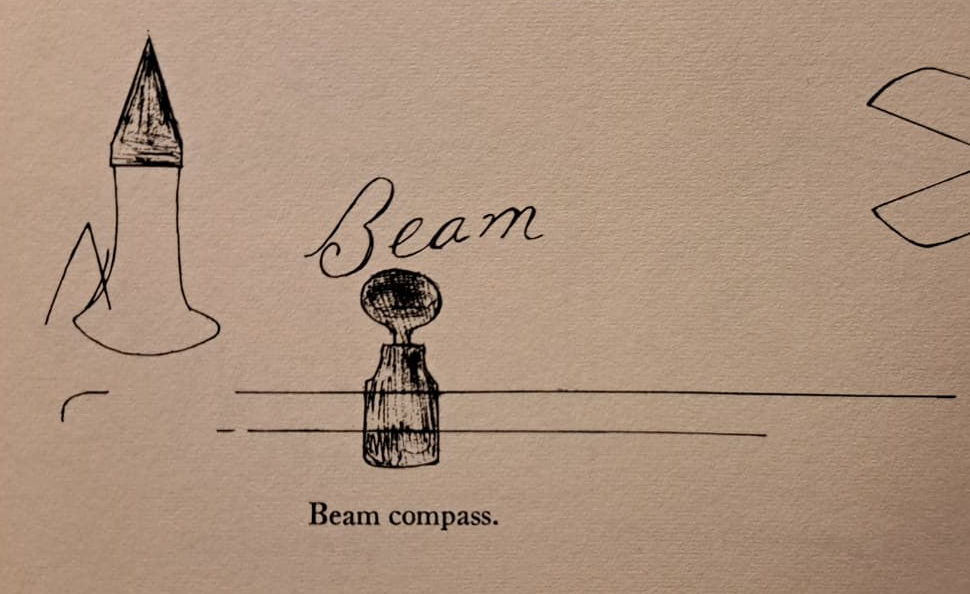
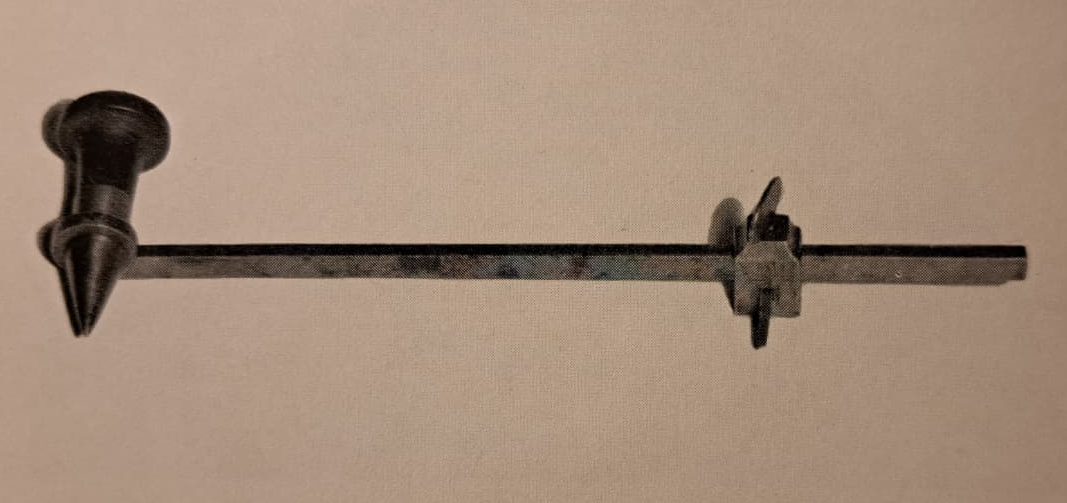
I spent a day making a beam compass fairly quickly. The thin brass disc would be very tricky to turn on the lathe and get such deep, consistent grooves, and hand engraving would be a laborious process. These types of compasses were also useful for laying out dials. Although none survives in the Dominy tool collection as far as I know, these types of compasses were common for clockmaking at the time, as one is illustrated in Daniel Burnap’s Memorandum Book from the late 1770’s (very contemporaneous with the Dominys), and several versions are offered for sale in John Wyke’s Catalogue of Tools for Watch and Clock Makers, also from the late eighteenth century.
Thank you to Tom Vaughn for telling me about using a beam compass for this task!
Here is the dividing plate on the engine.
Stay tuned for putting the rest of the engine together and using it.


Leave a Reply