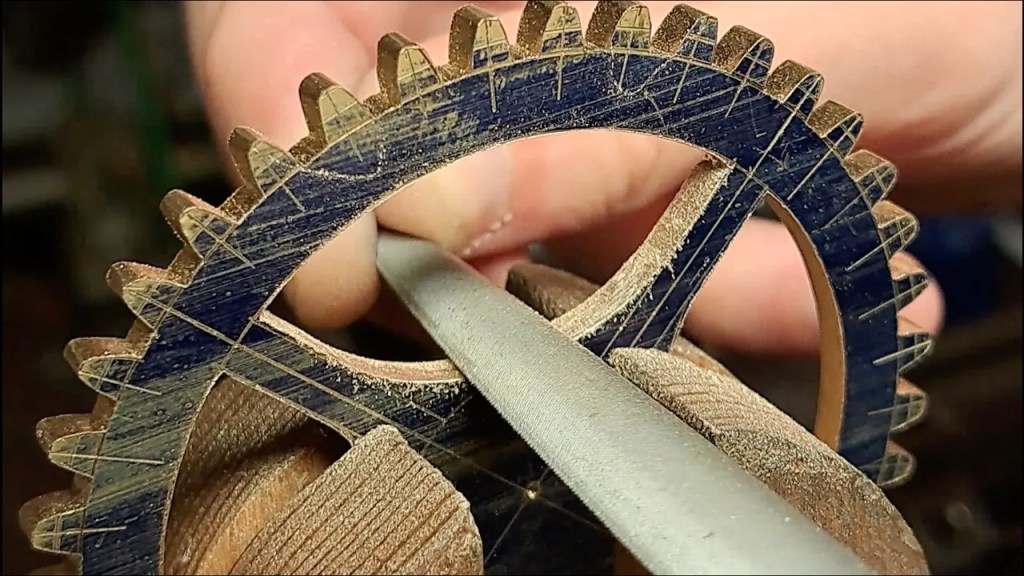
As part of my reconstruction of a wheel cutting engine, I cut a brass gear by hand with files, a saw, and a treadle-powered lathe. I did not use a dividing plate but rather marked the divisions straight onto the wheel. This is part of my reconstruction of an eighteenth century wheel cutting engine.
I modeled it on the first and largest gear in the Dominy’s engine, which they too cut by hand. Interestingly, the teeth on that gear are more rounded than pointed (like a romanesque arch rather than a gothic arch), so I tried to emulate than shape while filing.
Outside of a few pages by Theodore R. Crom, I have found surprisingly little written about making clock wheels without machine tools. I decided to take the opportunity while reconstructing the Dominy’s engine to explore how the wheels for the engine might have been cut in a variety of ways. So, for this first wheel I divided out the teeth using dividers straight onto the wheel, not using a dividing plate. This was a little tricky but not too difficult because there are only 30 teeth.
This process helped me appreciate the time and effort to cut teeth without a machine. It also prompted me to consider the order of operations. My sequence consisted of:
- laid out the wheel on a flat brass sheet (I blued it with Sharpie for better visibility)
- cut it round
- trued it on the lathe
- cut then filed the teeth
- and finally cutting out then filing the crosses.
The Dominy’s order was different and probably went something like:
- making a wooden wheel form complete with crosses
- casting it in brass
- truing in the lathe
- dividing it out (perhaps using an indexing plate, or perhaps directly onto the wheel as I have done here)
- cutting then filing the teeth
- filing the crosses
The main difference is I started with a flat brass sheet whereas the Dominys casted their own brass into a rough wheel form. It is uncertain when the crosses were filed, but I am confident they trued the wheel on a lathe before marking out the teeth divisions, based on marking lines still visible on some of their engine’s wheels. I am not sure when (or if?) they would have hammered the cast brass to harden it.
Next I will be making a dividing plate by hand and using it to lay out the divisions for the next wheel for the engine.
Postscript: If you are interested in the wooden vice I’m using while filing the wheel, see this post about it.
It’s similar to one in this late-sixteenth century (~1590) Flemish engraving of clockmaking:
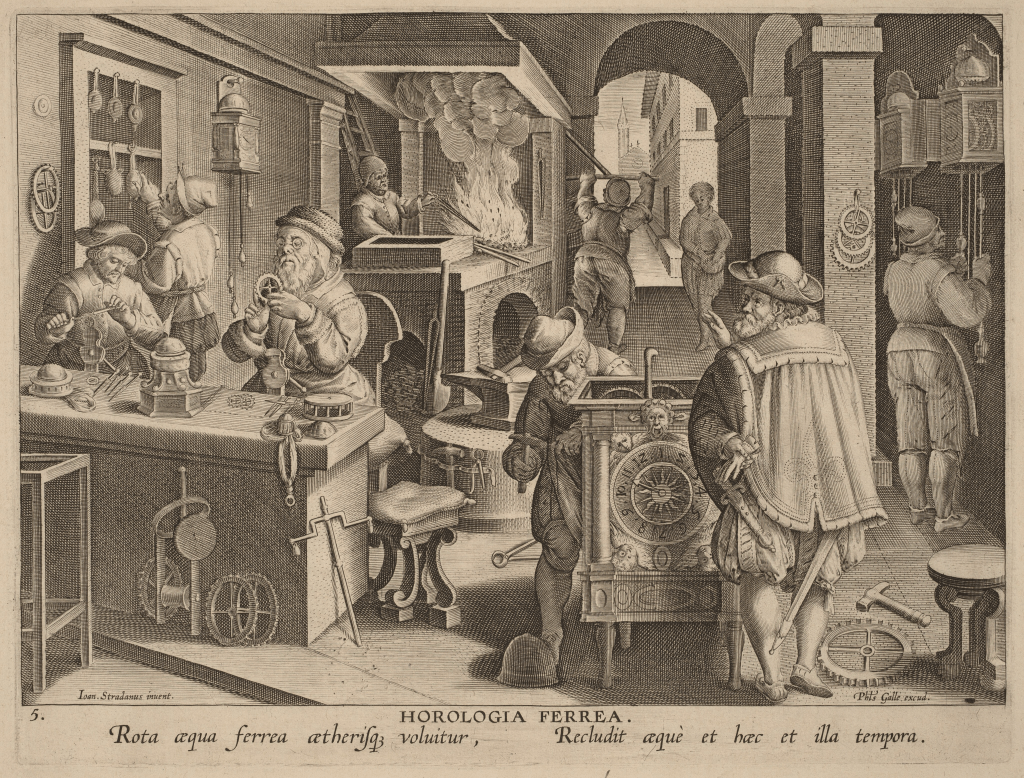
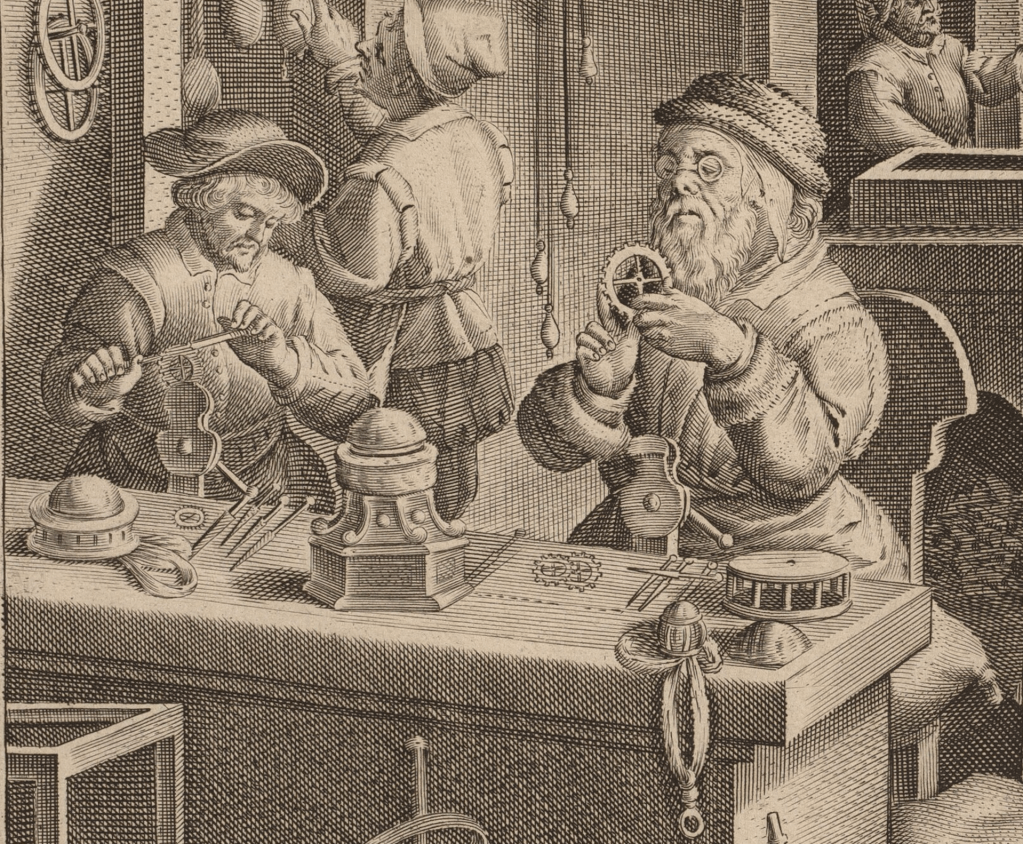
Source: https://www.nga.gov/artworks/48746-horologia-ferrea-iron-clocks


Leave a Reply