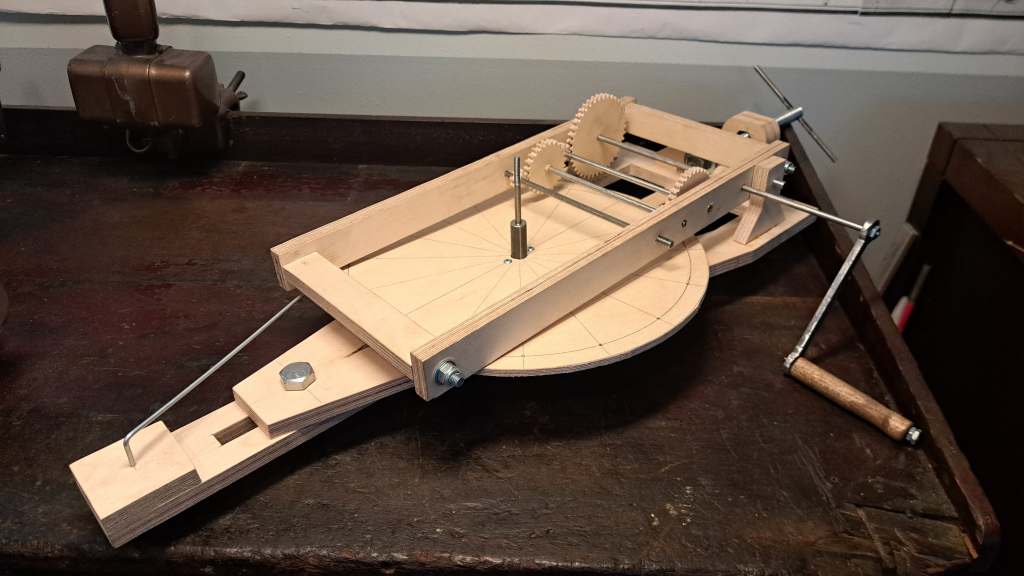
For my masters thesis at Winterthur, I have chosen to research a wheel cutting engine in the Dominy collection.
Made (or perhaps purchased or commissioned) in the 1770’s by Nathaniel Dominy IV, it is a tool used to aid in cutting the teeth on clock wheels. Compared to other wheel cutting engines, it has several quirks in its design – most notably is the 4 arbor gear train whereas other hand powered engines only have 2 arbors. The intriguing design, combined with the unprecedented wealth of surviving context in the form of tools, products, and documents allows me to study the role of a wheel cutting engine in a craft process in the late eighteenth and early nineteenth century.
To understand its capabilities and explore what exactly this tool did for the Dominys, I am reconstructing the engine. So far I have created a prototype out of plywood, dimensionally accurate in most ways, to get my head around the design, prompt construction considerations, and guide my research:
Obviously the materials and some of the construction techniques do not match the original, but even this quick reconstruction has been incredibly valuable to stimulating my understanding of the engine. Thinking through the order of operations in construction, discovering what tools and practices were required to make the engine, and encountering – really feeling – the effects of design decisions have induced many further lines of inquiry. This includes using the surviving tools from the Dominy’s workshop to determine what parts could have or could not have been made by them in-house, as it were. Looking at, for example, thread gauges, lathe capacity, blacksmithing capabilities, etc.
This process has also cued me into some key details of the design that require more consideration. The cone bearings used to support, and allow easy adjustment and removal, of the cutting wheel arbor have particularly piqued my interest – did the Dominy’s see a similar feature on another engine that inspired them? Or did they adapt the concept from their lathe, or another tool in their shop? Such specific solutions to problems constitute a crystallization of craft knowledge. Where was this knowledge produced?
While I could say much more, I will end this post with two intriguing questions I am pondering and excited to dig into: Where did all the currently unused holes in the engine frame come from? (Modifications or other configurations? Perhaps this tool could be set up in a different way…) And, why does it have a 4 stage train of gears? What is it about the Dominy’s practice, time, geography, etc. that means they produced an engine with a train of gears unlike any comparable wheel cutting engine I know of?!


Leave a Reply