
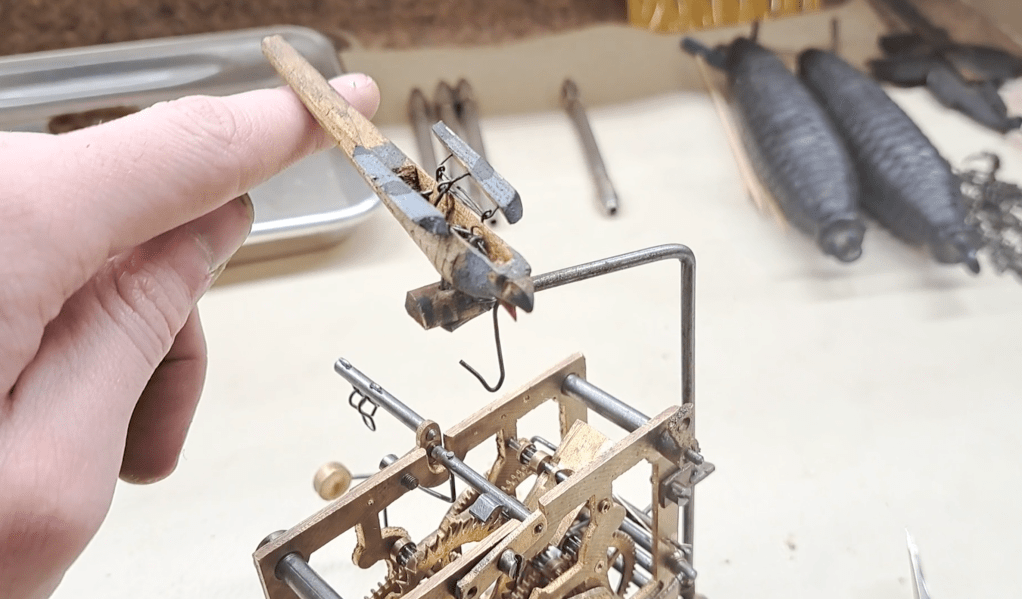
This is a cuckoo clock that was probably made between 1860 to 1914 in the Black Forrest in Germany (according to this). Aside from having cast bronze plates with a lyre pattern, the beautiful wooden bird that the mechanism puppets not only opens its beak but also spreads its wings!
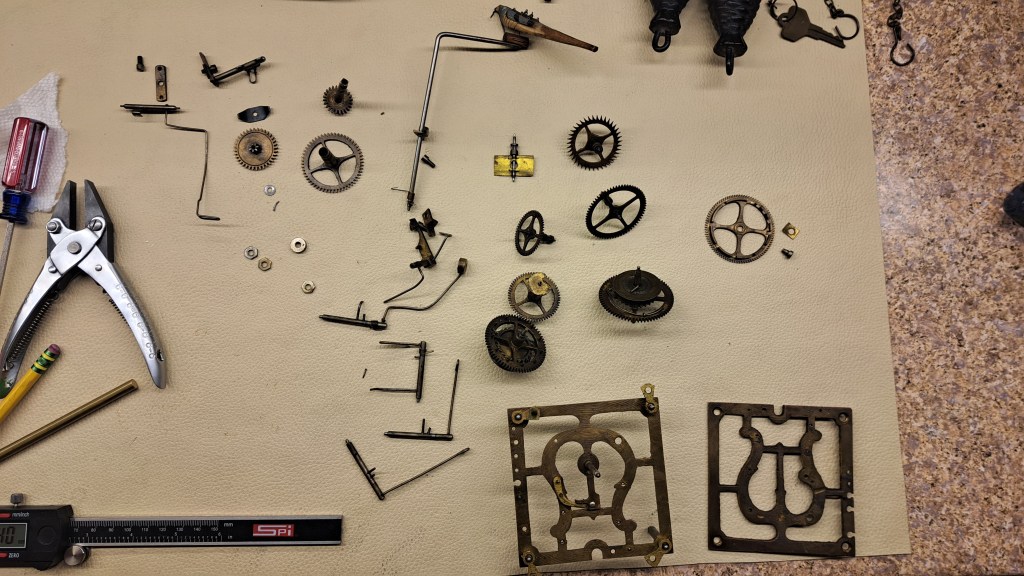
First I disassembled and cleaned everything.
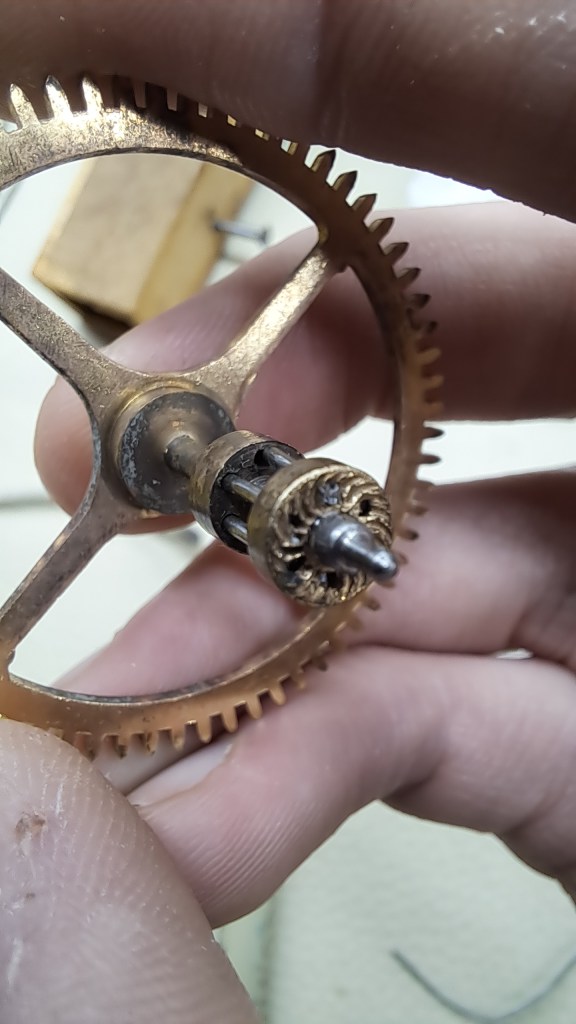
Along the way I noticed that this pin in one of the pinions had worked itself loose.
Now to admire the bird! Here’s a couple of videos showing the mechanism.
And here’s the movement all back together and striking the hour. The old bellows were disintegrating, so I replaced them.
And from the front. (Update: I fixed the door closing after every strike – the lever just needed bent to “ride” the count wheel more closely)
And ticking away.
I wrote about bird automata in chapter two of my thesis, and as I have been rethinking that research it is the representations of birds in particular that I keep coming back to. While some figures are represented mechanically only in a very specific context, I have found that bird automata show up in seemingly every instance humans make automata – from Hero of Alexandria in the 1st century, to those drawn by Villard de Honnecourt in the 13th century, and on snuff boxes in the 19th century.
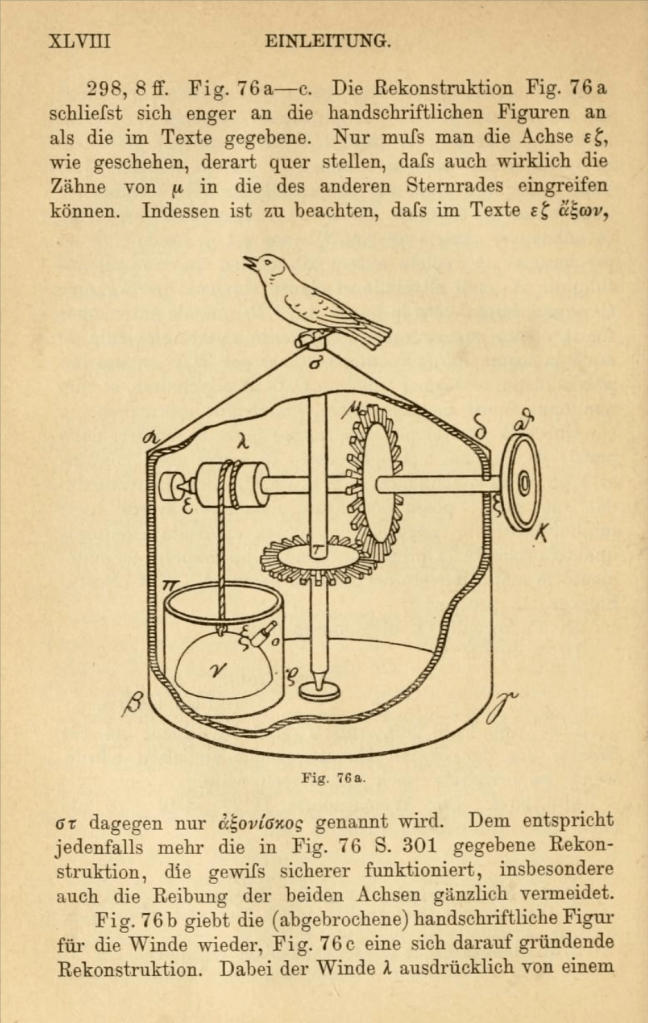
Illustration of mechanical bird from Hero of Alexandria, 1st or 2nd century AD (source)

Sketch of mechanical bird by Villard de Honnecourt, c.1225-1235 (source)

Jaquet Droz Singing bird snuff box, late 18th century (source)
What is it about birds that drives humans to mechanically recreate them again and again?
Several initial theories:
- Birds make simple, recognizable movements (wings move, beaks move) that are easy to render mechanically
- Birds make music, and music lends itself to mechanization (much more could be said of the relation between music and mechanism, including even on a fundamental level)
- Birds are associated with timekeeping, timekeeping was a mechanical issue for many centuries
- Birds are the right scale for mechanisms; springs, gears, and levers are easiest to make at a certain scale, and can only perform work at a certain scale, one which aligns well with the needs of mechanizing a bird
- Birds (as discussed in my other post) have associations both with regularity and freedom, and divine or whimsical nature and rote to-man’s-ends nature, that perhaps makes them an evocative subject to mechanize
- Birds themselves have simply an outsized role in myths, symbols, and stories humans tell…
I will certainly return to this topic in future projects.
“Once out of nature I shall never take
My bodily form from any natural thing,
But such a form as Grecian goldsmiths make
Of hammered gold and gold enamelling
To keep a drowsy Emperor awake;
Or set upon a golden bough to sing
To lords and ladies of Byzantium
Of what is past, or passing, or to come.”
– Yeats, “Sailing to Byzantium”
 What Will Makes
Leave a comment