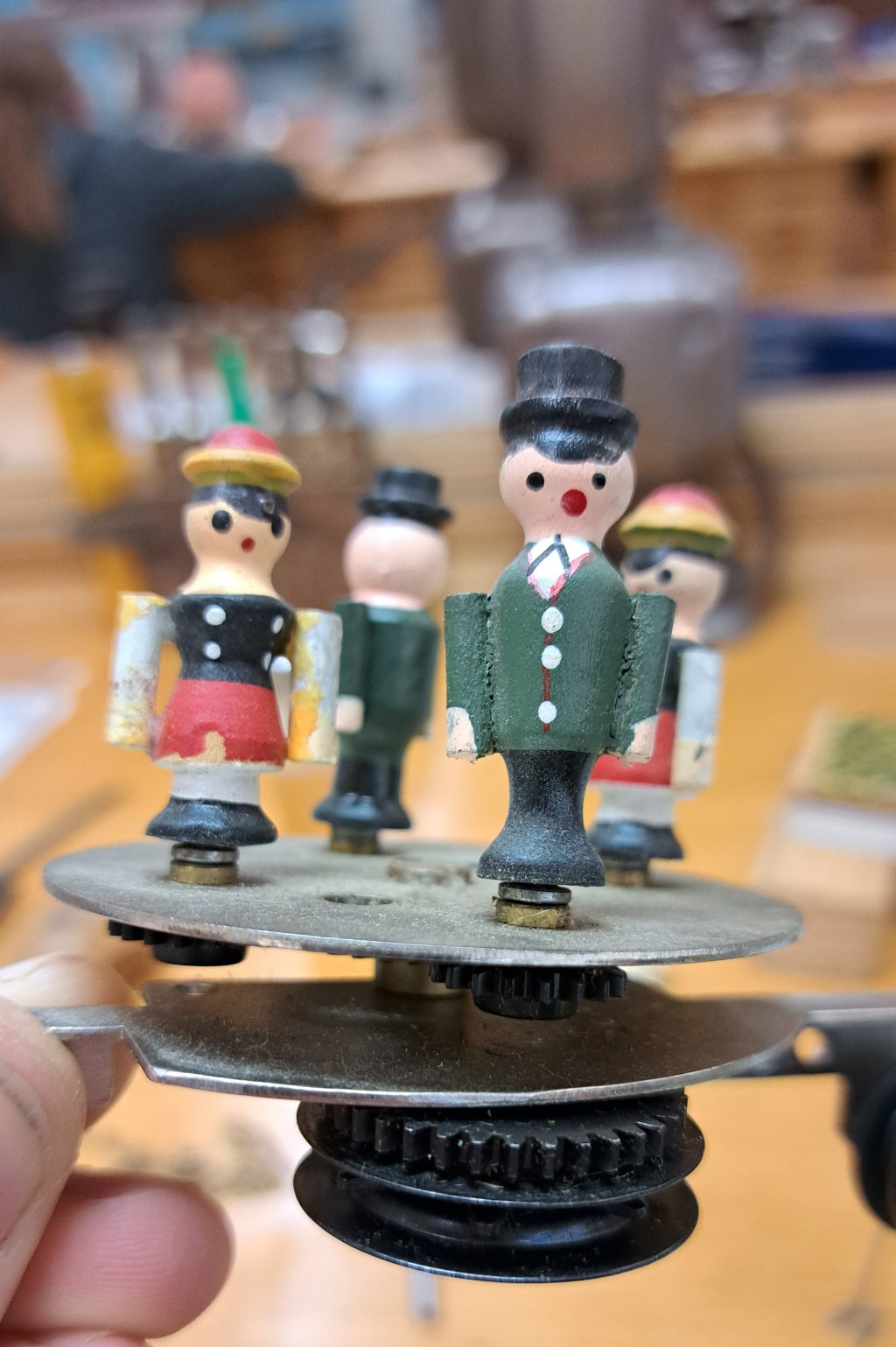
I won’t go into much detail about servicing these mechanisms as it was much the same as the basic cuckoo clock movement, but wanted to quickly document two of the common cuckoo clock variations: a second melody and dancing figures.
In this one the main movement with cuckoo triggers a second music-box assembly that plays a melody after the cuckoo call. This assembly has a cam and causes an accordion or organ-grinder figure to appear in a second window. The music box assembly, in this case at least, is situated above the clock movement on a shelf and the figurine swings down. It has a separate weight from the main movement – the only way they interact is that the main movement has a linkage that sets off the music box after the cuckoo is finished. Getting this linkage right is simply a matter of carefully bending some wires.

In this variation the cuckoo clock movement again triggers a music box mechanism, but this mechanism operates a turntable platform with rotating ‘dancing’ figures rather than just one simple figurine. The turntable has a sort of planetary gear arrangement on it and a sprocket that accepts a chain which is connected to the music box assembly.
In servicing this clock the routing of the chain from the music box to the turntable is critical.
Here you can see how the main movement triggers the music box.
And from the front.
I’m quite fond of the cuckoo clocks and find these variations very fun! I’m not sure of the validity of the history, but I’ve read that people did celebrate and perhaps dance when hearing cuckoos because they heralded the beginning of spring.
 What Will Makes
Leave a comment